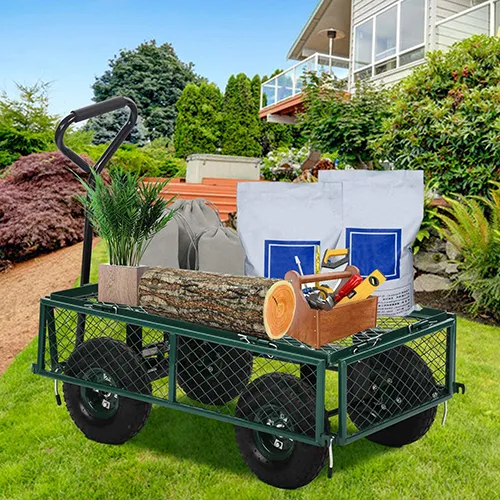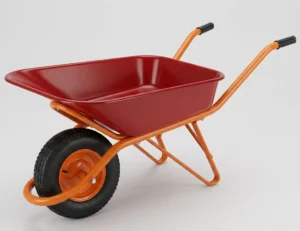
Ask any landscaper, nursery manager, or hardware store buyer what kills metal yard gear first. It is rarely a bent axle or a broken handle. It is rust.
Here is how it usually starts. A worker loads gravel, brick, or wet soil into a steel wheelbarrow or mesh garden cart. A flat-edge shovel scrapes across the bottom. The steel blade cuts through the paint. Two rainstorms later, an orange streak appears. By the end of the season, the paint bubbles up in sheets, and the steel tray starts to pit and flake.
The short answer: A single layer of liquid paint or basic powder coat cannot stop rust once a shovel cuts down to bare steel. To build a true rust resistant metal garden cart or contractor wheelbarrow, a factory must stop under-film rust creep. That takes a multi-layer system: proper steel cleaning, zinc phosphate pre-treatment, a corrosion-blocking base layer (E-coat, zinc-rich primer, or hot-dip galvanizing), and a UV-stable outdoor polyester powder topcoat. Pair that finish with drain holes and upgraded hardware, and a steel cart can last 5 to 10 years outdoors—even after hundreds of shovel hits.
Below is a clear, factory-floor guide to why scratches spread so fast, how the five main industrial coatings compare, and the exact lab tests B2B buyers should put in their RFQ.
Why One Shovel Scratch Destroys a Cheap Steel Cart
Paint looks tough in a showroom. On a job site, a thin layer of paint is easy to cut.
When a steel shovel or jagged rock gouges a cart bed, it creates a tiny trench down to raw carbon steel. Water, oxygen, and yard chemicals rush into that gap. Garden soil is not just dirt. It holds wet mulch acids, lawn fertilizers (nitrogen and potassium salts), lime, and manure. Those salts speed up rust like road salt on a truck frame.
The Problem of “Under-Film Creep”
Surface rust inside a thin scratch is ugly, but it is not what destroys the cart. Under-film creep is the real killer.
As raw steel turns into iron oxide (rust), it swells. Rust takes up roughly 6 to 7 times more volume than the solid steel it replaces. Think of it like ice freezing inside a cracked sidewalk. That expanding rust pushes outward and upward right beneath the paint layer.
On a cheap cart with poor metal prep, the paint has a weak grip on the steel. The swelling rust wedges the paint loose from the metal. Moisture creeps deeper under the lifted paint. Within a few months, a 2 mm shovel scratch turns into a 50 mm blister of flaking paint.
That is why buyers who only ask for “thicker paint” still get rusted returns. Thick paint without the right base layer just peels off in bigger sheets.
Surface Pre-Treatment: The Hidden Step Buyers Never See
You cannot coat dirty steel and expect it to last. Raw cold-rolled steel sheets and welded tubes arrive at the factory covered in mill scale, stamping oil, and weld spatter. If a factory skips deep cleaning, the coating sits on top of oil instead of metal.
Building a rust resistant metal garden cart starts long before the spray gun turns on. Three pre-treatment steps decide whether a scratch stays tiny or ruins the whole tray.
1. Mechanical Cleaning or Acid Pickling
Before chemical washing, the factory must strip away mill scale and welding slag.
- Shot blasting (abrasive blasting): Tiny steel shots hit the frame at high speed. This knocks off weld scale and leaves a microscopic rough texture (anchor profile). Coatings grip rough steel far better than smooth steel.
- Acid pickling: Used heavily on stamped wheelbarrow trays and mesh panels to dissolve rust and scale inside tight bends.
2. Multi-Stage Degreasing and Rinsing
The steel passes through heated alkaline wash tanks to strip cutting oils and fingerprints, followed by clean water rinses. Any leftover soap or oil causes pinholes and peeling later.
3. Iron Phosphate vs. Zinc Phosphate Conversion Coating
This is where budget factories cut corners—and where B2B buyers should pay close attention. After washing, the steel gets a chemical conversion bath:
- Iron Phosphate: Cheap and fast. It forms a very thin, smooth layer (typically 0.3 to 0.8 g/m²). It works fine for indoor office desks or dry tool cabinets. Outdoors, it offers weak defense against under-film creep once scratched.
- Zinc Phosphate: The commercial outdoor standard. It grows a tight, crystalline zinc-iron layer directly onto the steel (typically 1.5 to 3.0 g/m²). Those tiny crystals act like Velcro for the primer and powder coat. Better yet, when a shovel scratches the tray, the zinc phosphate layer helps block rust from creeping sideways under the intact paint.
Comparing 5 Industrial Coating Systems for Outdoor Carts
Not every buyer needs a shipyard-grade finish. A light homeowner garden wagon and a rental-yard masonry wheelbarrow sit at very different price points.
Use the table below to compare the five main coating systems used on metal garden carts and steel wheelbarrows. All salt spray ranges refer to ASTM B117 (5% salt fog at 35°C / 95°F) on properly pre-treated carbon steel.
| Coating System | Typical Total Thickness | Realistic ASTM B117 Salt Spray Life | Shovel Scratch & Creep Defense | Outdoor UV & Sun Resistance | Relative Factory Cost | Best Market Tier |
| 1. Liquid Spray Paint (Single Coat) | 25–40 microns (1.0–1.5 mils) | 24–72 hours | Poor (chips and peels fast) | Fair (fades quickly) | Lowest ($) | Low-end promotional / seasonal retail |
| 2. Single-Coat Polyester Powder | 60–90 microns (2.4–3.5 mils) | 240–360 hours | Fair (tough surface, but creeps once cut) | Very Good (with pure polyester) | Low–Mid ($$) | Standard retail garden carts & wheelbarrows |
| 3. Zinc-Rich Primer + Polyester Powder (2-Coat) | 110–150 microns (4.3–6.0 mils) | 500–1,000 hours | Very Good (zinc slows rust creep at cuts) | Very Good | Mid–High ($$$) | Contractor wheelbarrows & heavy mesh carts |
| 4. E-Coat (CED) + Polyester Powder (Duplex) | 80–115 microns (3.2–4.5 mils) | 720–1,000+ hours | Excellent (covers tight mesh welds 100%) | Very Good | Mid–High ($$$) | Premium fleet, nursery & commercial carts |
| 5. Hot-Dip Galvanized (Bare or Duplex Powder) | 45–85+ microns zinc (+ powder if duplex) | 1,000+ hours (years outdoors) | Best (sacrificial zinc heals small cuts) | Best (bare zinc never fades) | High ($$$$) | Coastal markets, farms, rental fleets |
Let’s look closely at how each system works in real yard conditions.
1. Liquid Spray Paint
Liquid paint is sprayed wet and air-dried or flash-baked. It is thin, uneven around sharp corners, and soft compared to baked powder. One morning of shoveling wet gravel strips liquid paint right off a wheelbarrow pan. For any brand that cares about return rates, liquid paint is off the table.
2. Single-Coat Outdoor Polyester Powder Coat
Powder coating uses dry resin powder charged with static electricity, then baked in an oven at 180°C to 200°C (356°F to 392°F). The powder melts into a hard, smooth plastic-like shell about 60 to 90 microns thick.
It resists bumps and rubs far better than liquid paint. On its own, however, powder coat is only a barrier. As long as the shell stays whole, steel stays dry. The second a sharp rock cuts through to the steel, rust can still start in the scratch.
Watch the powder chemistry: Some factories use epoxy or epoxy-polyester (hybrid) powder because it is cheaper and flows easily. Hybrid powder works great on indoor garage tool carts, but sunlight breaks epoxy down fast. Outdoors, hybrid powder turns chalky, dull, and brittle within 12 to 18 months. For any rust-resistant metal garden cart, your spec sheet must require 100% outdoor-grade polyester powder (TGIC or TGIC-free super-durable polyester).
3. Zinc-Rich Epoxy Primer + Polyester Topcoat (2-Coat Powder)
This two-coat system solves the biggest weakness of single-coat powder. First, the factory sprays a zinc-rich epoxy primer (40–60 microns). Then they apply a UV-stable polyester topcoat (60–80 microns).
Why does this work so well against shovel scratches? Two reasons:
- Sacrificial action: Zinc is more electrically active than steel. When a scratch exposes bare steel next to zinc primer, the zinc sacrifices itself slowly to protect the steel edge.
- Creep stop: Even if a deep gouge shows a hairline of rust, the zinc primer holds tight around the cut and stops the paint from blistering outward.
4. Cathodic E-Coat (CED) + Polyester Powder (Duplex System)
E-coating (Electrophoretic Deposition) is the same rust-proofing process used on modern car frames and pickup truck underbodies.
Instead of spraying, the entire welded cart frame or mesh panel is dipped into a huge water-based paint bath. An electric current pulls the coating onto every millimeter of bare metal. It reaches inside hollow handle tubes, behind folded tray lips, and deep into tight wire-mesh weld spots where a spray gun can never reach.
The E-coat layer is thin—usually 15 to 25 microns—and completely uniform. After baking, the factory applies a tough outdoor polyester powder coat on top. For a rust-resistant metal garden cart with expanded steel mesh sides, E-coat plus polyester powder is one of the smartest durability upgrades on the market.
5. Hot-Dip Galvanized Steel (HDG)
In hot-dip galvanizing, cleaned steel is dipped into a bath of molten zinc at around 450°C (840°F). The zinc does not just sit on top of the steel. It bonds into the steel surface, forming tough zinc-iron alloy layers that are often harder than the base steel itself.
Why landscapers love galvanized trays: When a shovel scrapes a galvanized wheelbarrow tray, the zinc layer provides cathodic protection. As long as the scratch is narrow (roughly 1 to 2 mm wide), the surrounding zinc protects the exposed steel edge from turning into deep pitting rust. You get zero paint peeling because there is no paint to peel.
If a brand wants custom Pantone colors on top of galvanized steel, factories can apply a duplex finish (galvanizing + sweep blasting + degassing-grade polyester powder). It costs more upfront, but it delivers near-indestructible outdoor life in coastal or rainy regions.
4 Structural Rust Traps Coatings Alone Cannot Fix
Even a 1,000-hour coating fails if the cart design traps water. After 20 years of building steel carts and wheelbarrows, we see rust start in the exact same four spots on poorly engineered units.
1. Steel Mesh Weld Crossings
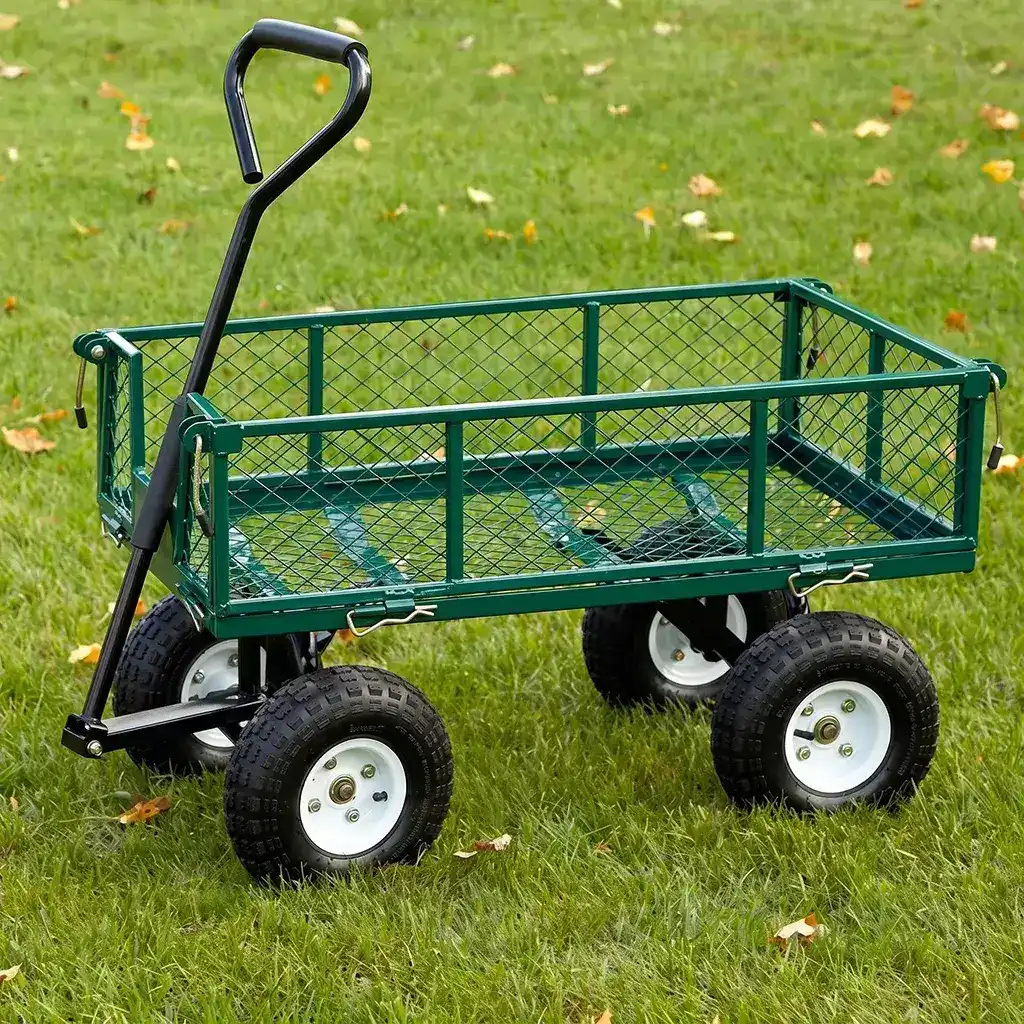
Look closely at a standard garden mesh cart. Where the diamond steel mesh meets the square angle-iron frame, there are dozens of tight weld pockets. Spray powder struggles to enter deep inside a 90-degree crevice because of a physics effect called the Faraday cage effect (the electrical charge pulls powder to the outer edges instead of the deep corner).
Rainwater sits in those bare weld pockets and bleeds orange rust down the sides.
- The factory fix: Use E-coating before powder coating, or weld full continuous seams instead of sloppy spot welds with open gaps.
2. Wheelbarrow Tray Bolt Holes and Rolled Rims
A steel wheelbarrow tray has four to six punched holes in the bottom where it bolts to the undercarriage. Punching a hole leaves raw, sheared steel edges. Every time the tray flexes under 300 lbs of concrete, the bolt heads grind against the paint around those holes.
Also, watch the rolled top rim of the tray. Water creeps inside an unsealed rolled bead and rusts the rim from the inside out.
- The factory fix: Always punch holes before pre-treatment and coating (never drill after painting). Add wide nylon or EPDM rubber sealing washers under carriage bolt heads to stop metal-on-metal grinding.
3. Hollow Tubular Steel Handles
Many homeowners and crews store wheelbarrows standing upright against a fence or shed wall. When it rains, water runs straight past cheap open grip caps and pools inside the hollow steel handle tubes. Because the inside of a steel tube is rarely painted, the handle rots from the inside out and snaps right at the bolt hole.
- The factory fix: Dip the handles in an E-coat tank so the inside walls get coated, seal the grip ends tightly, and drill small 4–5 mm drainage weep holes at the lowest point of the frame so trapped condensation can escape.
4. Cheap Fasteners, Axles, and Cotter Pins
You can spend extra money on a 2-coat powder finish, and the whole cart will still look rusty in 60 days if the factory uses cheap, thin electro-zinc bolts (5 microns). Those bolts rust in the first month and bleed ugly orange streaks down a fresh green or yellow cart frame.
- The factory fix: Specify zinc-flake coated hardware (Dacromet / Geomet) or 304 stainless steel bolts and lock nuts for exposed tray and handle joints, plus zinc-plated or greased axles with heavy cotter pins.
How B2B Buyers Verify Coating Quality (4 Real Tests)
Do not accept vague claims like “extra rust proof” or “heavy duty paint” on a supplier quote. If you are sourcing a rust-resistant metal garden cart or bulk contractor wheelbarrows, write these four recognized ASTM / ISO lab tests straight into your purchase order:
1. Dry Film Thickness (DFT) Gauge Check
Use a magnetic DFT gauge on finished production samples.
- Target for single-coat outdoor polyester: 70 to 90 microns (2.8 to 3.5 mils) on flat faces, with no bare thin spots under 55 microns on sharp mesh edges.
- Target for 2-coat (zinc primer + topcoat): 110 to 150 microns total.
- Watch out: Thicker is not always better. Powder applied above 180–200 microns can actually become brittle and chip off easily when hit by a falling rock.
2. Cross-Hatch Adhesion Test (ASTM D3359 / ISO 2409)
The QC inspector cuts a small grid of lines through the coating down to the steel, presses standard pressure-sensitive tape over the grid, and rips it off.
- What to require: 4B or 5B (on ASTM D3359, 5B means 0% coating peeled off; 4B means less than 5% flaking only at cut intersections). Anything graded 3B or lower means poor pre-treatment—reject the batch.
3. Neutral Salt Spray Test (ASTM B117)
Finished panels sit inside a heated fog chamber sprayed continuously with a 5% salt water mist at 35°C (95°F).
- Realistic commercial benchmarks:
- Standard retail outdoor cart (zinc phosphate + polyester): 240 to 360 hours with no blistering.
- Commercial / heavy-duty cart (zinc primer or E-coat + polyester): 500 to 1,000 hours.
- Reality check: Be skeptical if a low-cost vendor promises “1,000 hours salt spray” on a single coat of cheap powder coat with no primer. Physically, single-coat polyester over bare carbon steel rarely passes 360–400 hours without edge rust.
4. Scribed Creepage Test (ASTM D1654) — The “Shovel Scratch” Test
This is the single most useful test for garden carts and wheelbarrows. Before putting the coated sample into the ASTM B117 salt spray chamber, the lab scribes an “X” right through the coating down to bare metal. That cut mimics a real steel shovel gouge.
After 240 or 500 hours of salt fog, the lab measures how far the rust crept sideways under the coating from the cut line.
- What to require: Average under-film rust creep of less than 2.0 mm from the scribe line (Grade 7 or higher on ASTM D1654). If the paint peels back 5 to 10 mm from the cut, the cart will fail in the field.
Matching the Right Coating Tier to Your Market (B2B Cost Math)
Upgrading coating specs at the factory costs far less than most importers think—and saves a fortune in seasonal returns.
On a full 40HQ container order of steel mesh garden carts or 6 cu. ft. steel wheelbarrows, stepping up from basic iron-phosphate single powder to zinc phosphate + zinc-rich primer (or E-coat) + outdoor polyester powder typically adds only $2.50 to $5.50 per unit FOB, depending on tray surface area.
Compare that small factory upgrade against three real B2B costs:
- Outdoor retail display rust: Big-box hardware chains and local garden centers often stack assembled wheelbarrows and garden carts outside in the parking lot rain for months. Cheap carts start showing rust streaks before a customer even buys them, leading to markdowns and vendor chargebacks.
- 1-star online reviews: On major retail sites, the fastest way to sink a $120–$200 garden cart listing is customer photos showing peeling paint and rusted mesh corners after one summer.
- Warranty replacements: Shipping a single replacement steel tray or mesh panel by parcel courier easily costs $35 to $65—wiping out the net margin on five to ten sold carts.
Quick Tier Guide for Importers & Brands
- Value Retail / Homeowner Tier: Specify zinc phosphate pre-treatment + 75-micron UV-stable polyester powder + Dacromet/304 tray bolts. This keeps landed costs sharp while avoiding first-season rust complaints.
- Pro Contractor / Landscaping / Nursery Tier: Specify E-coat (or zinc-rich primer) + textured outdoor polyester powder (a lightly textured matte finish hides minor shovel scuffs much better than high-gloss paint!).
- Coastal, Marine, Farm & Equipment Rental Tier: Specify hot-dip galvanized trays/frames (bare or duplex powder-coated) paired with 304 stainless steel fasteners.
Protecting the Finish Before the Customer Even Uses It
A great factory coating can still get ruined inside a cardboard box during a 35-day ocean voyage. When ordering knock-down (KD) flat-pack garden carts or nested wheelbarrow trays, lock down these packing details with your factory:
- Nested wheelbarrow trays: Place thick foam sheets, Kraft paper, or corrugated spacers between every stacked tray. Bare steel trays rubbing together in container vibration will sand right through the powder coat before arrival.
- Isolated hardware and caster boxes: Never toss loose steel axles, bolts, or heavy wheel hubs inside the main carton next to painted mesh panels. Box all heavy metal parts separately with reinforced dividers.
- End-user care card (a smart brand touch): Print three simple tips right on the assembly sheet so customers get maximum life out of their rust-resistant metal garden cart:
- Rinse out wet fertilizer, lime, or salt after use.
- Store wheelbarrows angled or upside down off wet grass so water drains out.
- Dab any deep rock gouges with a quick coat of cold galvanizing spray or matching touch-up paint once a year.
Frequently Asked Questions
1. Is a powder-coated steel tray or a hot-dip galvanized tray better for a rust-resistant metal garden cart? If your buyers care most about maximum rust life in wet, coastal, or manure-heavy farm environments—and don’t mind an industrial silver finish—hot-dip galvanized steel lasts the longest because the zinc protects scratches automatically. If your retail or brand buyers want signature Pantone colors with strong outdoor durability, E-coat (or zinc-rich primer) plus outdoor polyester powder gives you both sharp visual appeal and 500–1,000 hours of salt-spray protection.
2. Can a factory powder coat directly over galvanized steel? Yes, but it takes careful process control. Hot-dip galvanized steel traps microscopic pockets of air and moisture in its porous surface. During oven baking at 190°C, that gas escapes and leaves tiny pinholes or blisters in the powder coat (“outgassing”). A qualified factory solves this by sweep-blasting the zinc, pre-baking (degassing) the parts, and spraying a degassing-grade (OGF) outdoor polyester powder.
3. Why does textured powder coat look better longer on garden carts than glossy paint? Glossy finishes act like a mirror—every minor shovel mark, gravel scuff, and dust smudge jumps out immediately. A fine-textured or sand-textured polyester powder coat breaks up light reflection, masks daily tool scratches, and hides wear on steel mesh decks and wheelbarrow trays for years.
4. What is the minimum order quantity (MOQ) for custom outdoor coating upgrades and brand colors? Custom Pantone outdoor polyester colors and upgraded two-coat (zinc primer or E-coat) finishes are standard on full or mixed 20GP/40HQ container runs. Exact MOQs depend on cart model and whether you are consolidating multiple SKUs—like garden mesh carts, wheelbarrows, and hand trucks—in the same production color batch.
Source True Rust-Resistant Garden Carts & Wheelbarrows Direct from the Factory
Stopping rust on outdoor steel gear is not luck—it is controlled manufacturing. From zinc phosphate pre-treatment and E-coat dip tanks to 100% outdoor polyester powder and upgraded fasteners, every layer works together so a routine shovel scratch does not turn into a rusted return.
With 20 years of metal fabrication experience, our factory builds heavy-duty rust-resistant metal garden carts, contractor steel wheelbarrows, drum dollies, hand trucks, and platform carts for North American, European, and Australian B2B brands. We back our finishes with in-house DFT checks, ASTM D3359 adhesion testing, salt-spray QC protocols, and mixed-SKU 40HQ container loading.
Need coating specs, ASTM test benchmarks, or a factory-direct quote for your next garden cart or wheelbarrow order? Browse our Heavy-Duty Garden Carts & Wheelbarrows or contact our engineering team with your target market and annual volume. We will send back a matched coating spec and container loading plan within 24 hours.